Showing posts with label Book Review. Show all posts

Sunday, 16 August 2015

How Music Got Free - Stephen Witt (2015)

How Music Got Free: What happens when an entire generation commits the same crime, is one of the most intriguing and thrilling reads I have had in a while. Written by Stephen Witt, this book (a first for the author) explores the history of music piracy, where it started, who was involved and how they did it, as well as what their motivations were. Now most people, including myself believed the piracy era began with Napster, but Witt takes things back even further to the invention of the MP3 by a German professor, and the actions of one man in a town called Shelby in North Carolina. This is the story of the MP3, its invention and who pirated the first MP3 music files.

By the mid-90s, music obsessives from small towns across America were rising up against the music industry which by the late-90s had reached its zenith financially under the leadership of Universal Records Doug Morris, the CEO of the largest and richest music label on the planet. Thanks to the success of the compact disc, the industry was booming, but this was about to come crashing down as a man by the name of Dell Glover began an operation smuggling albums out of the Polygram CD pressing plant where he worked. Glover used co-workers hiding CDs under their belts to break past a heavily secured facility. He then proceeded to upload the compact discs, many of which were yet to be released albums by the likes of Jay Z, Eminem and Tupac to an online secretive piracy group called Rabid Neurosis, or RNS for short. This was a network of people online who used pseudonyms and encrypted software to share music online in the form of the then much maligned mp3. It is believed 1500 CDs were smuggled out of the plant and uploaded to the internet, while over a decade RNS helped leak 20,000 albums. Forget Napster, these guys were the epicentre of music piracy in the late-90s and early-2000s. What started as a hobby, became a significant money-earner for Glover, and when it was at its most profitable, he earned upwards of around $1500 a week.

In the book, Witt also explores the invention of the MP3 in Germany by a professor called Karlheinz Brandenburg. The MP3 was designed as a way of compressing audio files to make digital storage easier. However, as Witt points out in the book, no one in the tech or music industry was interested in the MP3 and it lost out to the MP2, hence why music pirates ended up taking advantage of it for their own ends. The book shows Brandenburg, a highly intelligent man, to have been treated harshly by both the tech and music industries as he tried to get both the MP3 and MP3 player he designed patented. Phillips declined his MP3 player design, the first of its kind, while the music industry turned down the opportunity to embrace the MP3 in 1997. When Brandenburg recommended they adopt a copy-protected version of the file, the industries response was that they did not believe in electronic music distribution. Ultimately this decision would cost them an estimated $21 billion. The story behind the MP3 and the man who invented it is a fascinating and essential component of the book and the overall piracy story, simply because the decision of both the tech and music industry to not embrace MP3 led to music pirates getting their hands on the technology first.

The book also explores the rise of BitTorrenting and in particular the story of one of the first and most successful torrent sites Oink in the UK. The brainchild of Alan Ellis, at its peak, Oink had 100,000 users, while contained in its library was around one million albums. Ellis was again one of those music enthusiasts whose hobby got bigger than intended. He would later be put on trial for conspiracy to defraud and was found not guilty. The book ends with the music industry’s response to piracy and their operations to go after the pirates themselves, operations that initially involved targeting college students and children, not the main conspirators such as the members of RNS. By the time Glover and other members of RNS were caught and put on trial, it was too late for the music industry and the statistics offered up what was a grim reality for an industry in decline. Between 1996 and 2010, 100 billion files were shared, 21 billion dollars were lost, there were 50 million active down loaders online, 300,000 songs were ripped, and 25,000 albums leaked. Out of all of this, the music industry charged 150 people, and the man responsible for smuggling 1500 albums from the pressing plant he worked served only a three-month jail sentence.


“How music got free” is a fantastic read and is a must for anyone interested in the history of music piracy, the music industry, or how a culture of downloading bought the music industry to its knees, which incidentally it has never recovered from. This book is very well researched and incredibly detailed, while at times read like a fictional thriller. The further you get into the book, the more and more compelled you feel to keep reading and cannot wait to find out what happens next as the members of RNS plot their next leak. This is not a book about debating whether music downloading is good or not, or the pros and cons of piracy, this debate has been done to death and thankfully Witt goes down a completely different path with great success. For a first book this one will be hard to beat for Witt and is in fact a bit of a scoop for him. The thing is Glover has never been interviewed before on his life as a music pirate and his involvement in one of the biggest shifts the music industry has ever seen. When Witt asked Glover why he had never told anybody any of his story before, Glover responded “no one ever asked”. 

A+

- Sam 

Monday, 16 June 2014

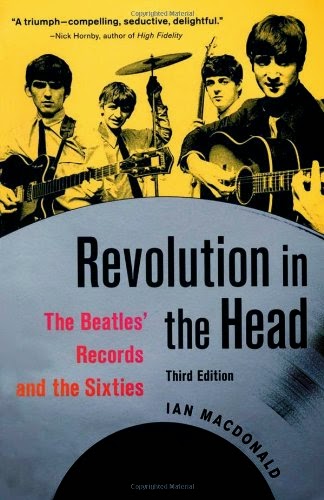
The Beatles - Revolution in the Head: The Beatles Records and the Sixties 3rd edition (2007)


In terms of popular music literature, I would hazard a guess that The Beatles have probably had more written on them than any other musician, despite the fact that most of that literature is sub-standard, lacking in quality and even in some cases factual information. This is definitely not the case with Ian McDonald’s book Revolution in the Head: The Beatles Records and the Sixties, which to my eyes is the most complete analysis of The Beatles and their music I have ever read.

Ian McDonald was a British music critic and author whom sadly passed away in 2003. But he has left a brilliantly researched and well written sociological and musicological Beatles bible. “Revolution in the Head” details every song the band recorded together in chronological order from 1961 to the reunion session sin 1995, describing in detail the music itself, the context behind it, the lyrics, and for some individual songs a complete backstory contextualising that song with the personal life of the writer and the cultural context of the time. Each entry is also accompanied by a list of the musicians who played on each song and how they contributed musically to that track, which in itself offers a very good insight into the way the band operated in the studio and also how multi-skilled they were at moving between different instruments. McDonald’s analysis and opinion of each song is very forthright and this book is certainly no Beatles love-in by any means, thank god, as often Beatles literature is reduced to nothing but praise for their achievements without considering their lesser moments both musically and personally. His musicological and sociological commentary is highly critical and he is not afraid to come out strongly against the songs themselves, the cultural climate of the 60s and even the band members and their personal misgivings while in the band. This makes “Revolution in the Head a refreshingly interesting, informative and un-biased read.

Aside from the main body of the book which contains the analysis of the music, the book also begins with an interesting essay titled “Fabled Foursome, Disappearing Decade”, an essay where McDonald offers an analysis of the major social and cultural changes of the 60s and the decade’s legacy thereafter in the 1970s and 80s. Here McDonald’s argument is that the Beatles represented a meeting point of three cultural trends which were crucial to the 1960s period, materialistic individualism, the radicalism of the new left, and the psychedelic pacifism of the hippy movement. McDonald then reaches the conclusion that the 60s as a whole had little in the way of a long-lasting influence on mainstream society, something which you can kind of see when you look at what followed during the me-decades of the 70s and 80s.


In conclusion, McDonald does a good job in placing the Beatles and their music within the context of the time, giving the songs some cultural and social meaning, especially their later more experimental work. I am also glad he avoided going down the line of attempting to interpret hidden meaning behind their lyrics and investigate potential hidden messages as many have made a life-time obsession out of, as this would only have served to distract from what is a very detailed and thoroughly researched analysis. If ever there was a book which highlighted how this band’s journey was a long and winding road both musically in terms of style and culturally it is this one. McDonald gives the Beatles story an honest and rigorous assessment, with no pre-conceived fandom encroaching on the story and the overall content. A must read for any music fan and also those interested in musicology and 60s-70s sociology. 

A+

- Sam 

Friday, 31 May 2013

Book Review: "All The Madmen" by Clinton Heylin (2012)


Written by Clinton Heylin and published in November 2012, “All the Madmen: Barrett, Bowie, Drake, the Floyd, The Kinks, The Who and a Journey to the Dark Side of English Rock” puts the microscope on six of English rocks biggest stars, who in the years following the often mythicized “Summer of Love” experienced various problems with their mental wellbeing, while often battling to maintain their sanity. In this fascinating and insightful read, Heylin explores the drug problems of Syd Barrett and Peter Green, the battle David Bowie faced over his identity in the guise of Ziggy Satrdust, the depression faced by Nick Drake and Ray Davies often in response to their lack of commercial success, and the eccentricity of Pete Townshend. Heylin also looks into how these musicians were able to take their own personal experiences and use them as fuel for their work, highlighting how during this period (the early 1970s) these great musicians used their somewhat fragile state of minds to produce some of the greatest British albums of all time. He puts the spotlight on the making of albums such as Quadrophenia, Ziggy Stardust, and The Dark Side of the Moon looking into the influences behind these albums and the themes they explore, as well as how a lot of the music on these albums came about as a response to how the likes of Bowie and Townshend were feeling at the time. This book is very well researched and pays great attention to detail in its subject matter, while Heylin does a good job in presenting what can often be sensitive areas to go into including the issues of drug abuse and mental illness in a carefully considered manner. I would recommend "All the Madmen" to anyone interested in rock history, as well as those interested in the psychological side of music making. "All the Madmen" is a highly informative and interesting read that examines an area which is often overlooked in rock history, the madness and mystery of its participants, and how psychology and self-examination came to play a massive role in influencing the art that was created.   
A+
- Sam

Tuesday, 21 May 2013

Book Review: "You Never Give Me Your Money: The Battle For The Soul Of The Beatles" by Peter Doggett

“You Never Give Me Your Money” takes apart bit by bit the breakup of one of the biggest bands that has ever been, and then puts the microscope on the relationships and squabbles that ensued between the band member and those close to them in the following decades. What this book highlights is that grown men do not always grow up, and that lawyers and managers in the music industry a lot of the time cannot be trusted when it comes to money. The book written by Peter Doggett also does a very good job in dispelling the myth that Yoko broke up The Beatles, emphasising strongly that tired friendships and the desire to develop as artists were more compelling reasons for this “inevitable” result. Although Doggett spends a lot of time looking into the bands legal issues using very big words which make no sense to me, the book is extremely well researched and does a good job examining the lives of The Beatles post-The Beatles right up to today. A truly insightful read for any music fan.

A-

- Sam